
Why do people need to trot out a moral justification for doing certain appalling things and not for others, asks Devangshu Datta

The auto sector has been among the worse-hit in terms of sales in the past two years.

The Bank Nifty is likely to be a bellwether.

If a stock predictably moves to the top of a defined range, hits resistance and drops back down to the bottom of the range where it hits support, it can be traded.

The 22-year-old Carlsen leads 5-3 and needs to score another 1.5 points in the next four games to wrest the title away.

Instead of starting an aggressive attack, Anand played very positionally, seeking a small advantage

Over the short to medium term, valuations are more likely to move down than up.

Although the current long-term bullish trend is intact, markets are awaiting clarity on the taper and the Assembly election results.

Trading through this coming week could be influenced by reactions to events in Europe and the US.

Net capital gains from the sector over a full cycle may be more than the gains logged by cyclical sectors.
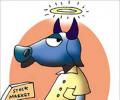
One may see five or six trend failures in succession before a trend sustains and takes off.

Akbar is rumoured to have once asked the navratnas of his court what the greatest pleasure in the world was. The stock answers came back: wealth, power, women, food, wine and so on, with the emperor's own contribution being hunting. Birbal was the outlier; he asserted that the greatest pleasure in the world was surely a good bowel movement.

In a bear market, prices may be irrationally depressed. In that case, an investor can identify mis-pricing, invest with a safety margin and wait. Since values are low, the risk is also low.
.jpg)
The latest macro-economic numbers confirm the economy trundles along in a low growth trajectory, while inflation climbs.

One could buy stocks cheap, sell if the market rises or do nothing. All these decisions would be correct.

Timing is crucial for a short-sell, so is an understanding of likely float.

Debt returns are always negative for investors in India, unless they are willing to take huge risk

If government statistics are at variance with private data flow, chances are high that the latter presents a picture closer to reality.

Though three stocks offer higher leverage via derivatives, be ready for some volatility.

The airline business has eaten up capital over the past century like almost no other business.
